I have recently converted my 1997 323i from auto to manual using a 1991 318i as a donor car for parts. There is some misinformation on the internet so this article is largely about correcting that. The missinformation predominately comes down to parts compatibility.
The main tool to work it all out, which is invaluable, is realoem. I donated.
Two quick notes about the conversion that would have saved me some time/effort. Firstly, when removing the automatic, the torque converter can be unbolted through a port in the cover plate, with the gearbox in place. Doing this allows you to drop the box virtually straight down, your sound insulation will thank you. Secondly, the automatic shift interlock cable needs to be retained. You can cut it off at the key barrel end, cut where the cable enters the white sleeve. I tried to install a bolt to enable the key removal but it's not that simple, needs a spring loaded pin which is in the interlock cable.
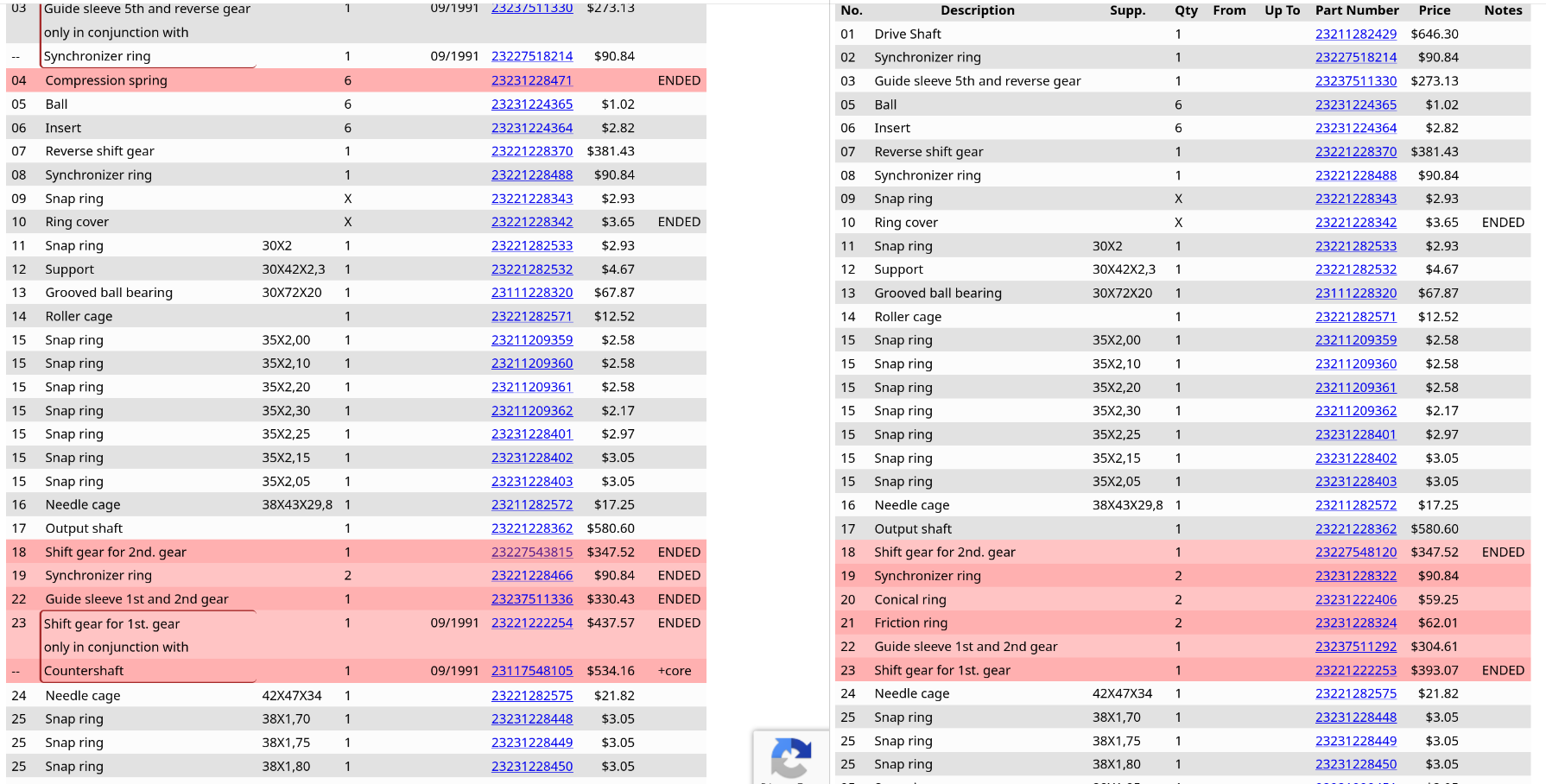
The internet says that all Getrag G250s are the same, so putting a 4 cyl GB into a 6 cyl car is equivalent to the factory box. This is incorrect, the 4 cyl GB has a suffix on the part number, mine was TBDH, whereas the 6 cyl GB has TAJT. The internals can be compared on realoem (image below, 4 cyl GB on left) which reveals that 1st and 2nd gear differ quite significantly, there are additional parts in the 6 cyl gearbox, and different part numbers for the gears themselves. I assume that the strength of the actual gear isn't different, but this could explain people blowing up synchros and related parts. Additionally, 1st and 2nd gear ratios differ, though probably insignificantly, and the 6 cylinder box has a larger oil capacity (these differences came from the owners manuals).
Having looked into this more, the 6 cylinder gearbox has discrete synchros on 1st and 2nd gear. First and second gear themselves are different part numbers, assumedly to interface with the different synchros. My opinion is that the strength of the gearboxes won't be different, but the 6 cyl gearbox will take 'spirited driving' better, 1st and 2nd synchros will last longer and behave better in general.
It's notoriously difficult to tell the difference between the 4 cyl and 6 cyl gearbox, potentially why people assume they are the same. There are no clear markings to identify them. Having gone through all this, one way of telling the difference is the hole size in the output shaft flange. The 6 cyl flange takes M12 bolts, whereas the 4 cyl flange takes M10 bolts (according to realoem).
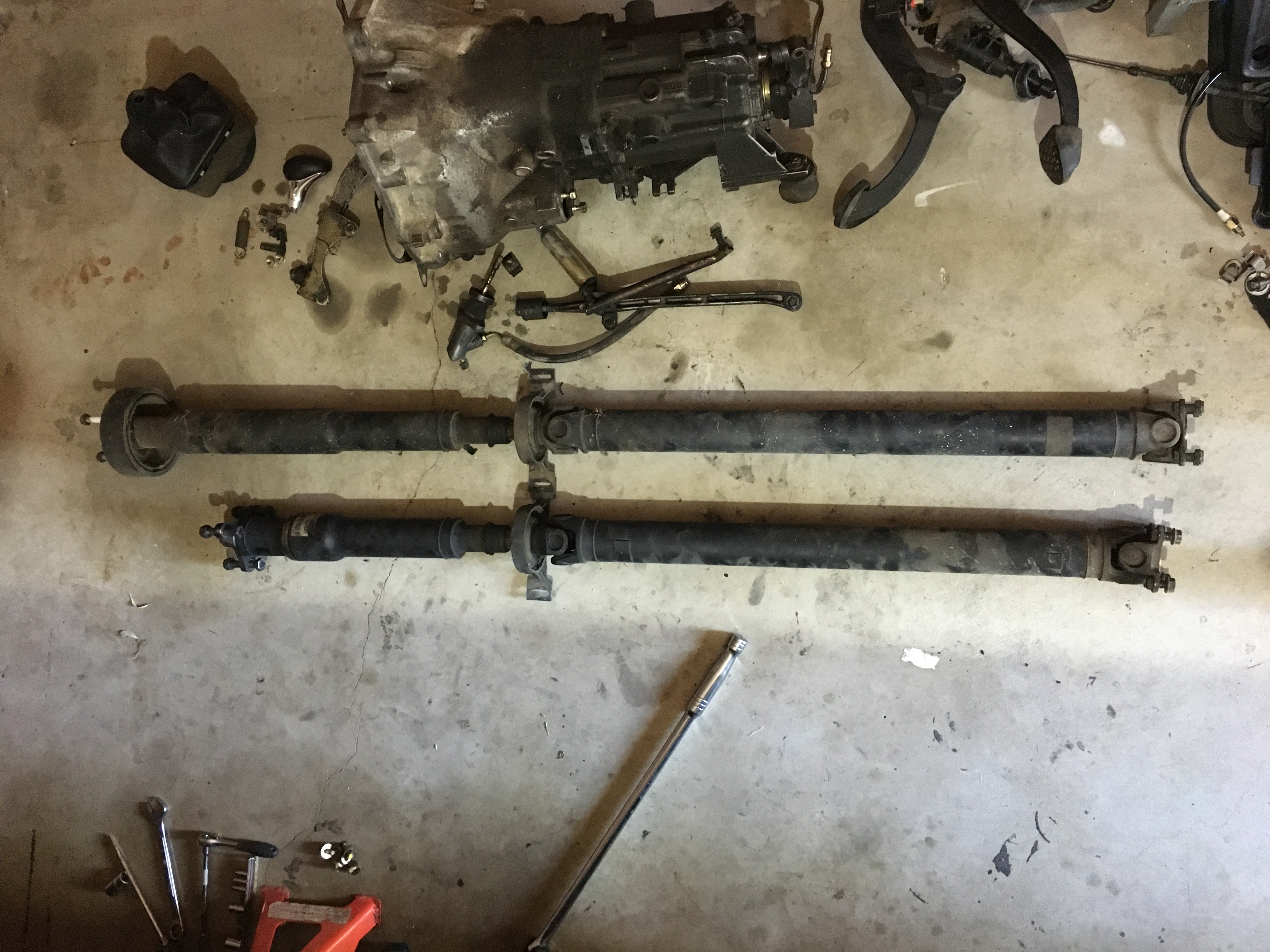
6 cylinder automatic drive shaft on the left, 4 cylinder manual drive shaft on the right. The front and rear are different lengths, the front depends on the gearbox, the rear depends on the diff. The 4 cylinder front will fit behind a 6 cylinder (noting the flange difference mentioned above), it needs to have the spline inserted a further 20mm (see shift linkages info below).
Another thing from what I've read, and comparing parts on realoem, it seems safe to remove the weighted ring at the front of the 4 cylinder driveshaft when it's used behind a 6 cylinder. This ring is a vibration damper and is only specified on 4 cylinder cars. The 6 cylinder driveshaft isn't just the 4 cylinder drive shaft without the damper though (they're different lengths at least), so do this at your own risk.
The 4 cylinder and 6 cylinder manual cross members are the same. I found out after ordering one new from BMW...
The 4 cylinder and 6 cylinder flywheels are different obviously. Turns out that the 323i flywheel is different too, the 320 and 325 flywheels are the same part numbers. The only difference I can see so far is that the 323i flywheel is about 10% heavier, the 323i was hobbled in other aspects too so perhaps this explains the different flywheel. I bought an m50 6 cylinder flywheel and installed the correct 323i m52 clutch on it, worked perfectly.
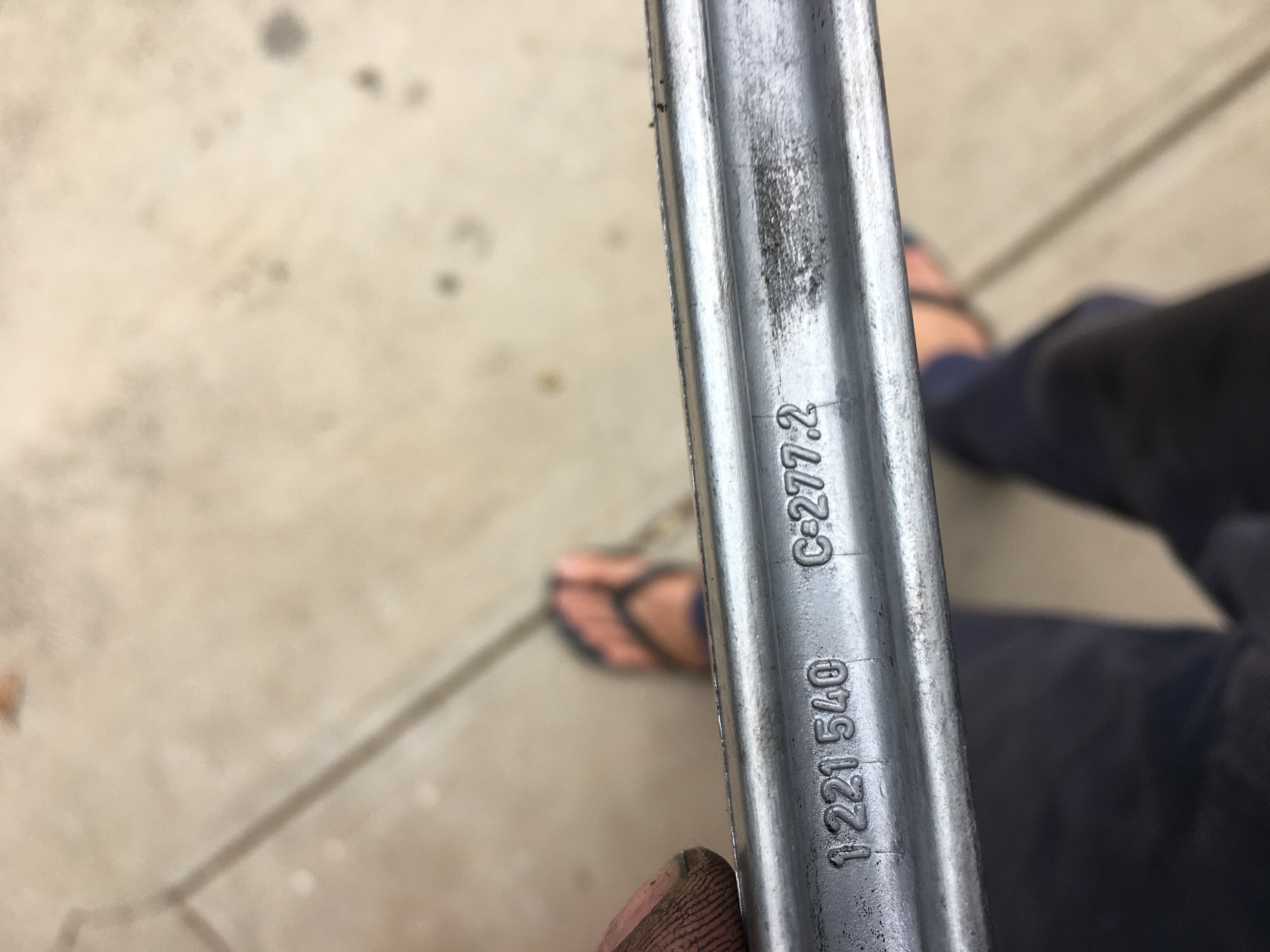
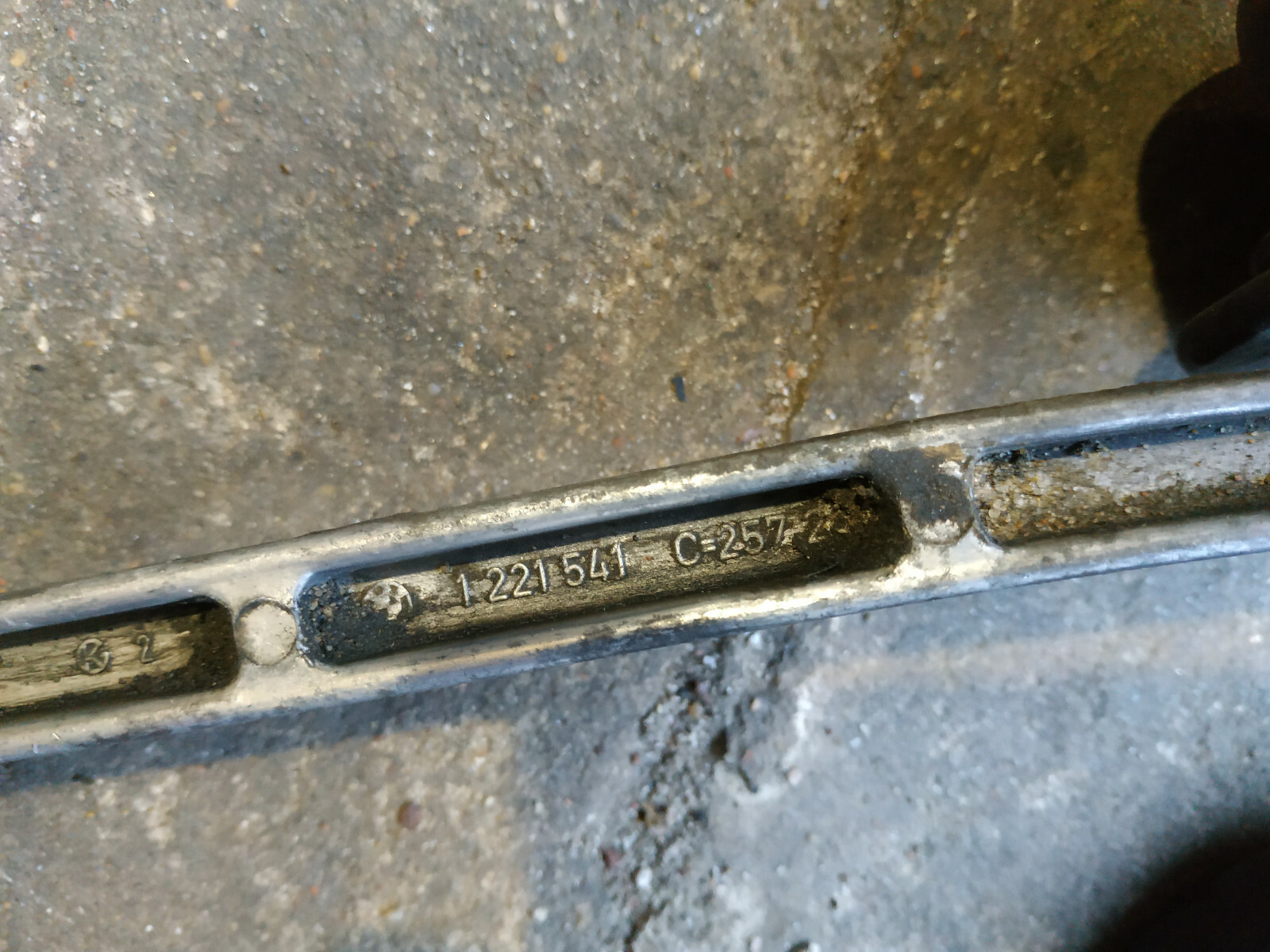
The 4 cylinder shift linkages need to be shortened but by how much seems to be a guarded secret, many people guess, some seem to measure. Turns out it's written on the shifting arms! So the shifting arm and linkage need to be exactly 20mm shorter. I also think it's safe to assume that the difference in lengths between the front section of the drive shafts is also 20mm.